martedì 19 luglio 2005

Arachnoiditis ossificans


Findings

Sagittal T1 (Figure 1) weighted MRI image of the lumbar spine with poorly defined nerve roots of the cauda equina. A bony fusion mass is noted posteriorly from prior remote bony fusion surgery.
Sagittal T2 (Figure 2) weighted image demonstrates heterogeneous mixed low T2 signal within the thecal sac at multiple levels.
Axial T1 (Figure 3) weighted image with poorly defined and "clumped" nerve roots.
Axial T2 (Figure 4) weighted image with heterogeneous mixed low T2 signal.
Axial noncontrast CT (Figure 5) image of the lumbar spine reveals extensive intrathecal calcification.
Sagittal reconstructed noncontrast CT (Figure 6) of lumbar spine demonstrates widespread intrathecal calcification and "clumped" nerve roots.


Diagnosis: Arachnoiditis ossificans


Arachnoiditis has many causes including prior surgery, myelographic contrast agents (especially oil-based contrast agents used in past), infection, subarachnoid hemorrhage, and inflammatory disease (ie, sarcoidosis). Lymphoma, carcinomatous meningitis, Guillain-Barre, and CMV radiculitis can also cause nerve root thickening. Chronic endstage archnoiditis results in arachnoiditis ossificans. Patients with arachnoiditis ossificans often have progressive neurologic deficits.

This case illustrates the importance of noncontast CT in evaluation of arachnoiditis ossificans, since MRI can demonstrate variable T1 and T2 signal characteristics.

mercoledì 6 luglio 2005

Schizencephaly


Findings

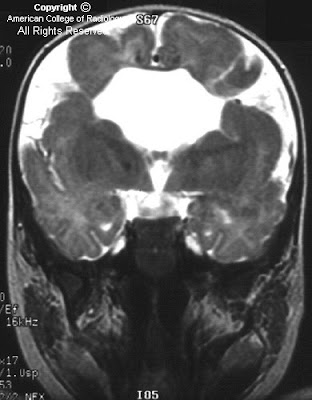
There are bilateral complete clefts in the posterior frontal parietal regions, with the lateral ventricles communicating openly with the subdural space. These clefts are lined with gray matter (polymicrogyria). The septum pellucidum is absent, and the corpus callosum is hypoplastic.


Diagnosis: Schizencephaly


Schizencephaly is a disorder of neuronal migration during embryogenesis of the brain in which clefts extend from the lateral ventricles to the pia. These clefts are lined by gray matter, may be unilateral or bilateral, and range in size from small slits to large gaps in the surrounding cerebral hemisphere. The etiology is unknown, but its frequent association with other disorders, including heterotopic gray matter, dysplasia of the corpus callosum, and absence of the septum pellucidum, points to a common error in migration. Other associations include the presence of arachnoid cysts, mega cisterna magna, and calcifications (best seen on CT). Clinically, epilepsy has been reported in 50-80% of cases of schizencephaly, more commonly in association with unilateral than with bilateral clefts; but the seizures tend to begin earlier and have a worse outcome with bilateral defects. The most common clinical finding is of asymmetrical muscle tone, which ranges from asymptomatic to paraparesis; increasing severity is associated with frontal location and bilaterality of clefts. Delay in motor skills, language deficits (more common in temporal defects), and hydrocephalus are also frequently encountered. MR is the modality of choice for diagnosis and for differentiation from porencephaly. The key finding is that the cleft is lined by gray matter, which is pathognomonic for schizencephaly. Other disorders of migration that may demonstrate enlarged or joined ventricles include lissencephaly and holoprosencephaly.

sabato 2 luglio 2005

Holoprosencephaly


Findings

Figure 1: The image shows a fetus with only a single cerebral ventricle. Its thalami are fused. The findings are suggestive of holoprosencephaly, especially alobar.
Figure 2:The image of the anterior face shows a single nostril suggesting a midfacial anomaly. Holoprosencephaly is often associated with midline facial anomalies.


Diagnosis: Holoprosencephaly


Holoprosencephaly is a malformation sequence involving the brain and often the face. It is a disorder of brain diverticulation resulting in partial or complete failure of cerebral hemisphere cleavage. Failure of cleavage results in failed formation of midline cranial structures. Midline brain development is associated with midface development and hence holoprosencephaly is associated with midface anomalies. Noncleavage of the primitive forebrain (the prosencephalon) leads to noncleavage in all planes. Associated olfactory and optic bulb anomalies occur because the prosencephalon, the primitive forebrain, does not cleave in a horizontal plane. A lack of proper cleavage in the transverse plane leads to improper formation of the telencephalon and diencephalon, which leads to abnormalities of thalamus and hypothalamus development. The often-seen fused or noncleaved thalami, as in the test case, may be a consequence. Finally, abnormal cleavage in a sagittal plane leads to abnormalities of the telencephalon, which normally forms the paired cerebral ventricles. In such patients an interhemisopheric fissure and other midline structures will not exist. The anomaly develops between the fourth and eighth week of embryonic life, well before the structures of the fetal brain can be adequately imaged by antenatal US. The abnormality is found in 1 in 16,000 live births, but in a larger number of fetuses and an even larger number of embryos (as high as 1 in 250), many of whom do not survive the pregnancy, hence affecting the numbers found among living births. There is a 12% recurrence rate for nonchromosomal cases.

Cases of holprosencephaly are divided into 3 forms. The most severe form, alobar holprosencephaly, typically results in a single holosphere (rather than 2 brain hemispheres), a single ventricle which often communicates with a dorsal sac, and fused thalami. There is no third or fourth ventricle, falx, corpus callosum, or interhemispheric fissure. The midbrain, brainstem, and cerebellum are typically normal unless made hypoplastic by mass effect of the large monoventricle or dorsal sac.

The intermediate form, ie, semilobar holoprosencephaly, shows at least partial prosencephalon cleavage. Temporal and occipital lobes may be separated. There may be a rudimentary interhemispheric fissure or a posterior falx. The incomplete form of holoprosencephaly, known as lobar holoprosencephaly, is the least devastating and may have a relatively normal appearing brain. There may simply be an absent septum pellucidum with an evident corpus callosum and perhaps fused or squared frontal horns. Rostral fusion may be the only ventricular abnormality with atria, occipital horns and temporal horns apparently normal.

When a child is born with a midline facial anomaly, a head US is performed to rule out holoprosencephaly. Facial abnormalities in cases of holoprosencephaly are variable. There may be none, or mild dysmorphism, such as hypotelorism or bilateral median cleft lip or palate. Cebocephaly, an intermediate form, has hypotelorism and a single nostrilled nose. Ethmocephaly is a more severe form of facial anomaly with severe hypotelorism, arhinia, and an interorbital single or double proboscis. Other severe abnormalities include cyclopia with variable eye and nose pairings. More significant facial anomalies are almost always associated with alobar holoprosencephaly.

Holprosencephaly is usually a terrible diagnosis no matter what its form. Those with severe brain abnormality, especially with arhinia or choanal atresia, die soon after birth if they survive the pregnancy. Less severely affected individuals may live several years but usually have severe neurologic and intellectual impairment. Even those with lobar holoprosencephaly who may live a normal lifetime may be severely retarded.

mercoledì 8 giugno 2005

Marchiafava-Bignami syndrome


Additional clinical history: The patient is an alcoholic.


Findings

CT shows mild prominence of the ventricles and sulci consistent with mild generalized cerebral volume loss. There is hypodensity involving the entire anterior and posterior corpus callosum. There are no intra or extra-axial fluid collections, midline shift, or mass effect. The basilar cisterns are patent. MRI shows abnormal T2 prolongation involving the entire genu and splenium of the corpus callosum. On T1, there is low signal intensity in the corpus callosum. On other images (not shown) there was no abnormal enhancement of the corpus callosum, and there was increased signal in the corpus callosum on diffusion weighted imaging.

Differential diagnosis for corpus callosum lesions:
- Ischemia
- Lymphoma
- Gliobastoma multiforme
- Metastasis
- Demyelinating disorders (MS, ADEM, PML)
- Marchiafava-Bignami syndrome
- Trauma shearing injury
- Toxoplasmosis


Diagnosis: Marchiafava-Bignami


Key points

Alcoholic patients and others with nutritional deficiencies may sustain demyelination of the corpus callosum, which may be considered a variant of extrapontine myelinolysis. It may also be more extensive and involve other brain regions. In an alcoholic patient with sudden onset of encephalopathy, this diagnosis should be considered. Marchiafava-Bignami syndrome is characterized by demyelination and central necrosis of the corpus callosum, often presenting with seizures, neurologic dysfunction, and coma. This is a rare syndrome with approximately 150 reported cases in the literature. There is a high incidence of mortality with this disorder. There is a subacute form which displays sudden onset of dementia progressing to the chronic vegetative state and a chronic form characterized by progressive dementia and a disconnection syndrome. The genu and splenium are often involved in the acute form and the body in the chronic form. Treatment is largely supportive and IV thiamine may be of some benefit.


Radiological overview

On non-contrast head CT, there will be hypodensity involving corpus callosum.

On MRI, there will be low T1 signal intensity in the corpus callosum due to edema and cystic change. There will be high signal predominantly in the genu and splenium on T2 weighted images. Diffuse weighted images are positive in the acute form signifying restricted diffusion and ischemic injury.

mercoledì 20 dicembre 2000

Sphenoid sinus mucocele


Findings

CT: Expansion of the sphenoid sinus by a soft-issue density. The clivus appears eroded.
MRI: Expanded sphenoid sinus. Homogeneous material is present within the sinus cavity which is both T1 bright and T2 bright. Mass effect is present on both cavernous sinuses. The sellar contents appear normal. There is no evidence of enhancement with gadolinium.


Diagnosis: Sphenoid sinus mucocele


Mucocele is the most common lesion to cause expansion of the paranasal sinuses and results from the accumulation of mucoid secretions within an obstructed sinus or an obstructed chamber within a septated sinus. Both mucoceles and mucous retention cysts are formed by cuboidal epithelium surrounding mucoid secretions. Mucoceles fill a sinus cavity when the draining sinus ostia are blocked, usually by inflammatory changes or a tumor.

Mucoceles are more common in adults and usually a history of prior sinusitis or sinus polyposis can be obtained. Mucoceles are more common in individuals with cystic fibrosis. Classic mucoceles are non-infected and present with complaints resulting from the mass effects such as proptosis, frontal bossing, inability to breathe through the nose, orbital mass (frontal or ethmoidal), medial gaze abnormality (ethmoid), or a change in voice pitch. Pain is unusual and implies super infection. The most commonly involved sinuses are the frontal (60%) > ethmoid (30%) > maxillary (10%) > sphenoid (1%). Sphenoid sinus mucoceles have the highest rate of surgical complications (blindness) reflecting their proximity to the optic nerves. Sphenoid mucoceles usually expand antero-laterally into the ethmoid sinuses and orbital apices. Expansion may also occur into the sella, the cavernous sinuses, into the nasopharynx, or intra-cranially (rarely).


Diagnosis

Sinus expansion can occur with mucoceles or neoplasms. The CT appearance of a soft tissue mass can be similar to mucocele. Sinusitis does not expand the sinus cavity. Surrounding bony sclerosis suggests infection. Calcifications may be present with superimposed fungal infections.


Therapy

Surgical drainage (transsphenoidal marsupialization into an adjacent sinus cavity).


Radiology

Plain film: The sinus may appear clouded, and the normal scalloped contour is lost as the mass enlarges. The normal white mucoperiosteal line is poorly seen. If preceded by chronic sinusitis, the sinus bones may show reactive bony changes.
CT: Mucocele usually appears as an expanded sinus cavity filled with material of homogeneous mucoid attenuation (10-0 HU). Rarely the material is of higher attenuation thought due to a higher protein content. Mucoceles generally do not enhance.
MRI: Signal is dominated initially by water content (95%). With chronicity (several months) the protein concentration and viscosity of the fluid increase and so does the T1WI signal. Usually T2WI bright; may decrease with time and lower water content.

martedì 12 dicembre 2000

Orbital lymphoma


Findings

CT(I-) axial and coronal images show bilateral proptosis, left greater than right, and bilateral extraconal soft tissue density masses in both the anterior and posterior portions of the orbit. The masses are contiguous with the lacrimal glands. No gross evidence of bony destruction.


Diagnosis: Orbital lymphoma


The extra nodal presentation of non-Hodgkin's lymphoma is common. Lymphoid masses account for approximately 10 to 15% of all orbital masses. Lymphoid neoplasms of the orbit include a wide range of classifications ranging from reactive lymphoid hyperplasias to benign pseudotumors to malignant lymphomas. Approximately 75% of patients with orbital lymphoma have or will have systemic lymphoma. The most common cytologic forms of malignant lymphoma involving the orbit are the histiocytic and lymphocytic types. Whether malignant lymphomas actually originate in the orbit and disseminate to the rest of the body or whether they represent metastatic sites remains unknown.

Lymphoid neoplasms of the orbit most commonly present in the sixth or seventh decades. True lymphoid tissue in the orbit is found in both the lacrimal glands and the subconjunctival tissue. Most of the lymphoid neoplasms occur at these two sites. Lymphomas tend to occur in the anterior portions of the orbit, most commonly involving the lacrimal glands, the eyelids and the subconjunctiva. In patients with lymphoma, the development of symptoms tends to be indolent and progressive. Symptomatology depends on whether the disease involves the anterior or retrobulbar portion of the orbit. With retrobulbar disease, patients may present with proptosis, eyelid swelling and pain.
In contrast, patients with pseudo-lymphoma (pseudotumor) present at a younger age with symptoms that develop suddenly and progress rapidly. Extensive signs of inflammation, eyelid erythema, pain, visual loss and motility disturbance may be present. Orbital cellulitis is an important consideration in the differential diagnosis.


Radiology

CT shows homogeneous, sharply marginated, mildly enhancing mass or masses of soft-tissue density which frequently mold to preexisting structures. No bony erosion or enlargement of the orbit.

mercoledì 6 dicembre 2000

Melanoma of the ciliary body


Findings

Findings: MRI (axial T1 pre- and post -gadolinium, axial T2): There is increased T1 signal and decreased T2 signal with in the region of the medial ciliary body of the left orbit, which demonstrates enhancement after the administration of gadolinium.


Diagnosis: Melanoma of the ciliary body


The uvea (choroid, iris, and ciliary body) is derived from neuroectoderm and mesoderm and may develop tumors from both origins. Malignant melanoma is the most common primary intraocular tumor of adulthood. It arises from the choroid in 75% of the cases but the iris, the ciliary body and the optic nerve head are other sites of reported involvement. Those involving the ciliary body and choroid are thought to originate from preexisting nevi. Metastatic sites of primary uveal melanoma include the liver, lungs, bones and kidney in order of decreasing frequency. The demonstration of the tumor in relation to the sclera is important as the prognosis is worse in-patients with tumor extension beyond the sclera.

The most common malignancy found in the orbit is a metastatic deposit. The richly vascularized choroid layer is the most common site of involvement. Malignant cells gain access to the globe by way of the bloodstream via the posterior ciliary arteries explaining why most deposits are in the posterior portion of the eye. Breast, lung and kidney carcinomas have the highest incidence of ocular involvement.


Treatment

Small choroidal melanomas (less than 10mm in diameter and 3mm in thickness) have a generally favorable prognosis with a 85-90% survival rate at 5 years. Clinically stable choroidal melanomas (no visible increase in size) are managed by serial observations by clinical exam, and CT or MR imaging. Distant metastatic disease and extraocular extension, however, has occurred in visibly stable lesions. With evidence of tumor growth, enucleation and wide local excision is performed.


Radiology

Uveal melanomas can be detected by ophthalmologic exam, fluorescein angiography ,or sonography. Both MR and CT are accurate in determining the size and location of uveal melanomas but MR is superior in assessing for the presence of retinal detachment or vitreous change and for differentiating uveal melanoma from choroidal hemangioma or choroidal detachment.

Uveal melanoma usually appears as a well defined, solid mass but when hemorrhagic or necrotic foci are present, the heterogeneity can cause diagnostic problems. Organized subretinal hemorrhage may have MR characteristics similar to uveal melanoma.

MR: Uveal melanomas are unique among the malignant tumors in that both T1 and T2 are shortened secondary to the paramagnetic properties of melanin. Melanin produces a stable free radical signal under all known conditions which enhances proton relaxation. The degree of shortening corresponds to the melanin content. The lesion is hyperintense on T1 weighted images and hypointense on T2 weighted images. MR imaging can not differentiate amelanotic melanoma from other tumors.

CT: Elevated, sharply marginated, hyperdense lesions demonstrating mild to moderate enhancement following contrast administration