Visualizzazione post con etichetta Toxic-Metabolic. Mostra tutti i post

venerdì 10 dicembre 2010

Wernicke’s Encephalopathy


Findings

On axial images, abnormal FLAIR signal is demonstrated at the pontomedullary junction adjoining the fourth ventricle, periaqueductal gray matter in the pons and midbrain (Figure 1), the superior aspect of the mamillary bodies (Figure 2), the tissue surrounding the third ventricle and the medial thalami (Figure 3).
On coronal slices, abnormal FLAIR signal again appears in the mamillary bodies (Figure 8), in the tissue surrounding the third ventricle (Figure 8 and Figure 10), medial thalami (Figure 10), and periaqueductal gray matter (Figure 11).


Diagnosis: Wernicke’s Encephalopathy


Wernicke’s encephalopathy is caused by thiamine deficiency, most often seen in chronic alcohol abuse. It has also been described in anorexia nervosa, prolonged starvation, hyperemesis gravidarum, patients on long-term hemodialysis, and patients with AIDS. Patients with this condition classically present with the triad of ataxia, acute mental confusion, and oculomotor dysfunction, although a minority (16-38%) of patients with the condition present with all three elements. If the symptoms also include amnesia and confabulation, then these manifestations are called Korsakoff syndrome. Wernicke’s encephalopathy is a significantly disabling and potentially lethal condition that can be prevented and reversed if treated early with thiamine supplementation.

On CT and MR imaging the brain demonstrates diffuse cerebral and cerebellar atrophy. Mamillary body enhancement or abnormal T2 signal may be the sole manifestation of Wernicke’s encephalopathy. Other typical MR findings include symmetric high T2 signal and variable enhancement within the periaqueductal gray matter of the midbrain, the tectal plate, the mamillothalamic tract, the thalami, and the tissue surrounding the third ventricle. The mamillary bodies may also show atrophy in patients with chronic Wernicke’s encephalopathy, though this finding can also be present in chronic alcoholic patients without Wernicke’s syndrome. Atypical changes may also be seen, almost always in non-alcoholic patients, and may include signal changes in cranial nerve nuclei, basal ganglia, cerebellum and dentate nuclei, the splenium, and frontal and parietal cortex. These atypical findings are very similar to the pattern seen in metronidazole-induced encephalopathy, and it is has been hypothesized that the two syndromes share a common metabolic pathway. The reason why these brain regions are more affected by thiamine deficiency is poorly understood, but it is speculated that they may be characterized by more intense thiamine metabolism.

martedì 7 dicembre 2010

Methotrexate neurotoxicity


Additional clinical history: Patient was diagnosed with acute lymphocytic leukemia 2 months previously. He is status post induction therapy with a negative bone marrow biopsy, and is currently receiving consolidation chemotherapy with methotrexate, and presents with right upper extremity weakness.


Findings

MR images of the brain demonstrate a focal area of diffusion restriction involving the left frontoparietal white matter. There is minimal associated T2/FLAIR hyperintensity. No associated enhancement. Remainder of the brain was within normal limits.
Imaging done four months later shows lesion has nearly resolved.


Diagnosis: Methotrexate neurotoxicity


Discussion

Methotrexate is a folic acid analogue. Its cytotoxic effects are carried out through inhibition of the enzyme dihydrofolate reductase, which reduces tetrahydrofolic acid levels, ultimately inhibiting cell division.

From bone marrow cell precursors to the quickly dividing cells of the intestinal tract, methotrexate exerts its effects on all dividing cells in the body. One of its rare side effects is CNS toxicity. The decreased folate levels achieved with methotrexate have implications on metabolism of adenosine, homocysteine, and biopterin. Low folate levels lead to a subsequent decrease in S-adenosyl-methionine(SAM) concentrations. This eventually leads to chronic demyelination and neurologic symptoms.

An additional side effect of MTX is the elevated levels of adenosine in the CSF. Adenosine is a vasodilator, which causes dilatation of cerebral vasculature resulting in neurotoxicity. The increased homocysteine levels caused by MTX have been shown to damage vascular endothelium and lead to subsequent strokes and thromboemboli. Methotrexate has also been found to cause cytotoxic edema, which is the most common cause of lesions that enhance on MRI DWI.

The neurotoxicity caused by MTX can be immediate, acute to subacute, or delayed. Symptoms of the disease can range from headache, nausea, vomiting, and fever, to transient or permanent focal neurologic symptoms. The immediate form occurs within a day of MTX administration and presents as a chemical meningitis. The acute to subacute form presents from days to weeks after administration of MTX, and presents with seizures or focal neurologic symptoms. The delayed form presents as leukoencephalopathy and a generalized decrease in higher cognitive function.


Radiological findings

A case series containing nine cases of MTX neurotoxicity revealed that lesions found in this disease tend to be focal and show up on DWI as well as T2 and FLAIR imaging. These abnormalities can continue to persist on imaging long after the symptoms have resolved. The DWI shows diffusion restriction with T2/FLAIR hyperintensity being less conspicuous.

In another independent case study on MTX neurotoxicity, MRI demonstrated restriction diffusion with no significant T2 or FLAIR signal abnormality. Based on a combination of these imaging findings, it was determined that cytotoxic edema was likely the cause of focal neurologic symptoms on the patient, and demyelination was a less likely cause based on the MRI findings.

A different case study had MRI findings showing subtle signal changes in the left centrum semiovale, with an obviously abnormal area of restricted diffusion, indicating the presence of increased fluid. The authors of this case also mentioned a relation between elevated choline levels in lesion areas with myelin breakdown.

The lesion in this disease is similar in appearance to ischemic stroke, but differs in distribution. The lesions in MTX neurotoxicity can show up in many different patterns, whereas ischemic strokes often follow a vascular distribution, helping differentiate the two.


Radiology

MRI:
MRI with DWI is the gold standard for diagnosis
Will show focal areas of demyelination and/or edema throughout the brain
Can be normal, even in the presence of symptoms
Must perform early to avoid unnecessary workup


CT:
Can be used to rule out other etiologies that may cause focal symptoms, but is not a sensitive test for demyelination and edema found with MTX neurotoxicity
Ultimately need MRI to make diagnosis as CT is often negative
Angiography
Not very useful as it is usually normal

mercoledì 10 novembre 2010

Methotrexate (MTX) induced transient neurotoxicity

14-year-old child with history of Acute Lymphoblastic Leukemia (ALL), on induction chemotherapy complaining of left sided weakness and facial asymmetry of acute onset.


The patient was given supportive treatment and aminophylline, symptoms resolved and an MRI was repeated after 3 days.


Findings

Diffusion weighted images with corresponding ADC maps show restricted diffusion involving bilateral centrum semiovale (Figure 1 and Figure 2).
Diffusion weighted images with corresponding ADC maps, from the MRI done after clinical improvement, show resolution of abnormalities seen on DW and ADC Maps in the initial study (Figure 3 and Figure 4).


Diagnosis: Methotrexate (MTX) induced transient neurotoxicity


With improvements in antileukemic treatment there has been a steady increase in long term survivors of ALL. However a myriad of neurological complications are seen during and after treatment. These maybe broadly categorized into those related to chemotherapeutic agents, radiation therapy, coagulopathy, immunosuppression and marrow transplantation.

Methotrexate is an essential component of treatment regimens in ALL. It can be administered both intravenously and intrathecally. Though hematologic and mucocutaneous consequences are more common, the CNS adverse effects are more worrisome. Chronic leukoencephalopathy as a result of methotrexate and radiotherapy is a well recognized complication and usuallly associated with cognitive deficits rather than focal neurologic deficits although subacuteacute encephalopathy after methotrexate may occur as well and usually presents as headache, confusion, disorientation, seizure, and focal neurologic deficit. A vast majority of patients show hemiparesis and aphasia.

High level of adenosine is thought to be responsible for methotrexate induced toxicity. Statistically the periventricular white matter is the most common area affected. On diffusion weighted imaging these areas show increased signal intensity and hypointensity on corresponding apparent diffusion coefficient (ADC) maps. There may be no abnormality identified on T1, T2, and FLAIR sequences during the acute symptomatic phase.

Clinical resolution is followed by the appearance of residual FLAIR hyperintensities in the involved areas, which show gradual regression. There is no established treatment, however several anecdotes report symptomatic resolution with aminophylline therapy.

giovedì 16 settembre 2010

Wernicke’s encephalopathy


Findings

There is increased T2 signal and diffusion restriction in the thalami bilaterally. There is no contrast enhancement.


Diagnosis: Wernicke’s encephalopathy


Discussion

Wernicke's encephalopathy occurs with vitamin B1 (thiamine) deficiency. It is associated with malnutrition and is commonly seen in alcoholics. Wernicke's encephalopathy manifests itself as memory loss, ataxia and oculomotor dysfunction. Thiamine plays a vital role as a cofactor for several enzymes involved in carbohydrate metabolism. Without thiamine, the energy requirements of neuronal cells are not met resulting in cell death and neurologic dysfunction.

Wernicke's encephalopathy is reversible and if suspected, treatment should begin promptly. Parenteral thiamine should be administered promptly. The thiamine should be given prior to any glucose infusion. The addition of glucose in a thiamine deficient patient will exacerbate the encephalopathy. Patient's with thiamine deficiency are also likely to be hypomagnesemic and parenteral magnesium sulfate should also be administered.


Radiologic overview of the diagnosis

Wernicke's encephalopathy manifests itself as increased T2 signal in the medial thalami, hypothalamus and periaqueductal grey matter. There is associated diffusion restriction in affected areas. In chronic cases, there is atrophy of the mamillary bodies. The sensitivity of MR to diagnose Wernicke's is estimated at approximately 50% so the lack of these imaging findings, do not exclude the diagnosis of Wernicke's encephalopathy. CT is even worse than MR in the diagnosis of Wernicke's and should be used to rule out an acute intracranial process. Alcoholic induced Wernicke's will manifest the same above findings, but will also show superior vermian atrophy.

In this case, there is increased T2 signal and diffusion restriction in the medial thalami bilaterally. There is no contrast enhancement. The patient has lymphoma and a chronic history of vomiting. With this history, Wernicke's encephalopathy was thought to be the cause of the patient's altered mental status. The lack of contrast enhancement makes the diagnosis of lymphoma highly unlikely.

lunedì 9 novembre 2009

Heroin induced leukoencephalopathy


Findings

Figure 1 and Figure 2: Axial T2 weighted images demonstrate diffuse high signal throughout the supratentorial white matter involving the centrum semiovale and corona radiata. There is sparing of gray matter and subcortical U-fibers. There is focal high signal in the peripheral left frontal region which corresponded to an area of acute infarct on diffusion weighted images and ADC map.
Figure 3 and Figure 4: Axial FLAIR images demonstrate diffuse high signal in the centrum semiovale and internal capsule extending to the frontal and parietal lobes with sparing of the basal ganglia and thalami. There is focal high signal in the peripheral left frontal region which corresponded to an area of acute infarct on diffusion weighted images and ADC map.


Diagnosis: Heroin induced leukoencephalopathy ("Chasing the Dragon")


“Chasing the dragon” also known as “chinesing” or “Chinese blowing” is a practice which involves inhaling the vapor of liquefied heroin. A small amount of white powder is placed on a piece of foil which is then heated from below. A stream of vapor, which looks like a dragon’s tail, arises from the molten heroin (the “dragon”) and the drug user “chases” it with a pipe or straw. This practice has gained popularity because one forgoes the risks associated with IV drug use while still benefiting from a rapid rate of absorption and onset of effect of the drug.

Heroin induced spongiform leukoencephalopathy is a progressive disease that was first described in the Netherlands in 1982. The heroin used is often impure with many additives and there is speculation that one of these additives becomes activated when heated and is the cause of the leukoencephalopathy. Since the first reported cases, many substances in the pyrolysate have been studied as potentially leading to the leukoencephalopathy but none has been positively identified. The damage is irreversible and there is no cure for this disease. Treatment is supportive care although there is a questionable benefit to using coenzyme Q and vitamin supplements.

Heroin induced leukoencephalopathy is diagnosis often made clinically and should be suspected in patients with a history of "chasing the dragon". The natural course is variable and not well defined. There may be a latent period with a subclinical evolution of white matter degeneration. Additionally, it appears that patients with higher levels of exposures have more severe disease. Patients often present in one of three clinical stages. The first stage consists of cerebellar signs (such as ataxia), apathy and motor restlessness. The second stage is comprised of tremors or myoclonus, chorea and athetosis, and pyramidal tract signs. The third stage consists of hypotonic paresis, stretching spasms, central pyrexia, akintetic mutism, and death. Progression of the disease continues even after cessation of the toxin for up to 6 months.

On pathology, there is symmetric spongiform degeneration, specifically in the cerebral and cerebellar white matter as well as the corticospinal and solitary tracts. The MR images illustrate this distribution, showing symmetric high signal on both T2-weighted and FLAIR sequences in the white matter of the cerebellum and occipital, parietal, and temporal lobes with relative frontal sparing. Specifically, there is involvement of the cerebellum and the posterior limb of the internal capsule, with sparing of the anterior limb and subcortical white matter. FLAIR images can demonstrate regions of subtle white matter abnormality more reliably and are better at excluding gray matter involvement than the T2 weighted images. There can also be additional signal abnormality in the splenium of the corpus callosum, the corticospinal tracts, and the lemniscal pathway in the brainstem. The spinothalamic tracts are spared which help to distinguish heroin induced leukoencephalopathy from other potential causes of encephalopathy. MRS in patients with heroin leukoencephalopathy has shown abnormally elevated intracerebral lactate in the affected white matter as well as decreased levels of N-acetyl aspartate in the white matter, gray matter, and cerebellum.

martedì 21 luglio 2009

Subacute combined degeneration


Findings

MRI of the thoracic and cervical spine show increased T2 signal within the posterior columns and the lateral corticospinal tracts on axial imaging. On sagital imaging, a longitudinal T2 signal abnormality is noted within the dorsal cord. There was no significant contrast enhancement status post gadolinium administration.

Differential diagnosis:
- Subacute combined demyelination
- Multiple sclerosis
- Astrocytoma
- Spinal cord infarction
- Infectious myelitis


Diagnosis: Subacute combined degeneration.


Vitamin B12 deficiency is the result of a malabsorption syndrome and can affect the brain, optic nerves, peripheral nerves and spinal cord. When patients present with myelopathy, such as sensory disturbances, weakness, and spasticity, it is known as subacute combined degeneration (SCD).

Clinical presentation of SCD is caused by dorsal column, lateral corticospinal tract, and sometimes lateral spinothalamic tract dysfunction. Patients initially present with paresthesia in the hands and feet, which can progress to sensory loss, gait ataxia, and distal weakness particularly within the legs. If the disease goes untreated, ataxic paraplegia may evolve. On physical exam, there is a loss of vibratory and joint position sense, weakness, spasticity, hyperreflexia, and extensor plantar responses. The diagnosis of B12 deficiency is made by serologic studies showing low serum B12 level; if the B12 level is borderline, elevated levels of homocysteine and methylmalonic acid help cinch the diagnosis.


Neuroradiology

Radiologic manifestations of SCD may be seen on MRI imaging, primarily within the cervical and thoracic spine, and include the following spinal manifestations:
- Mild spinal cord expansion and hypointensity on T1 weighted imaging.
- Increased T2 signal intensity primarily within the dorsal columns +/- lateral columns.
- Longitudinal dorsal cord T2 signal abnormality.
- Inverted "V" or "rabbit ears" T2 signal intensity within the dorsal spinal cord on axial imaging.
- Possible mild dorsal column contrast enhancement, with enhancement signifying breakdown of the blood nerve barrier.


Differential considerations

Although these MRI findings are consistent with SCD, they are nonspecific and include a broad differential diagnosis: demyelinating disorders, infectious etiologies, inflammatory conditions, ischemia, contusion, and neoplasms. However, SCD can be distinguished from other differentials given its bilateral nature of T2 signal abnormality over multiple levels that is confined to specific white matter spinal tracts. There can be partial to full reversal of MRI abnormalities following B12 therapy, with fifty percent of patients fully recovering and with the greatest recovery occurring when treatment is began in the early stages of the disease.

Multiple sclerosis is a demyelinating disorder with multiple lesions separated in time and space. MRI spine findings included increased T2 signal intensity and hypo or isointense T1 signal within lesions. These lesions, however, are more focal and well-circumscribed in nature compared to the contiguous lesions of SCD and show homogenous, nodular, ring enhancement of acute and subacute lesions status post contrast administration. Multiple sclerosis lesions rarely spans more than one or two vertebral segments and are usually not symmetric in nature.

Astrocytoma of the spine is an intramedullary glioma, more often located in the cervical than thoracic spine. This lesion presents as a hyperintensity on proton density and T2 weighted imaging, and almost always enhances. On T1 imaging, there is cord expansion, usually less than four segments. Again this is distinguished from SCD by location (intramedullary T2 signal intensity versus dorsal and lateral columns) and contiguity (SCD is contiguous over multiple vertebral segments).

Spinal cord infarction causes permanent tissue loss in the spinal cord secondary to vessel occlusion and usually presents hyper acutely. On MRI imaging, focal T2 hyperintensities can be seen in the gray matter, gray matter with adjacent white matter, or an entire cross section of the cord. These lesions are usually within the thoracic cord as it is an arterial border zone. T2 hyperintensities may also bee visualized within the anterior vertebral body bone marrow or deep medullary portion near the endplate secondary to vertebral body infarction. Diffusion weighted imaging shows restricted diffusion in the affected areas of the cord. Slight cord expansion and decreased signal is noted on T1 imaging. The MRI lesion distribution, bony involvement and diffusion changes differentiate spinal cord infarction from SCD.

Infectious myelitis can be secondary to HIV vacuolar myelopathy, varicella-zoster/herpes, or Lyme disease. On T1 imaging, there is cord expansion that nearly fills the spinal canal and variable, nonfocal enhancement status post contract administration. On T2 imaging, there is diffuse increased signal intensity throughout the involved segment, secondary to a swollen edematous cord. Unlike SCD, the signal abnormalities are not limited to the spinal tracts. However, MRI imaging findings may be identical to B12 deficiency and in such cases, can be distinguished by clinical presentation and laboratory findings.


martedì 9 giugno 2009

Paradichlorobenzene intoxication with encephalopathy


Findings

Shown are proton density and T2 axial images of the patient’s brain. The white matter is diffusely hyperintense on long TR sequences, including corticospinal tracts in the brainstem, cerebellar white matter and corpus callosum. The thalami and basal ganglia appear diffusely hypointense on long TR sequences.


Diagnosis: Paradichlorobenzene intoxication with encephalopathy (recreational mothball sniffing and eating)


Paradichlorobenzene (p-DCB, PDB; 1,4-DCB) is a volatile chlorinated hydrocarbon, a fat-soluble chemical. The primary exposure to 1,4-dichlorobenzene is from breathing contaminated indoor air. Acute (short-term) exposure to 1,4-dichlorobenzene, via inhalation in humans, results in irritation of the skin, throat, and eyes. Chronic (long-term) 1,4-dichlorobenzene inhalation exposure in humans results in effects on the liver, skin, and central nervous system (CNS). No information is available on the reproductive, developmental, or carcinogenic effects of 1,4-dichlorobenzene in humans.

Paradichlorbenzene (which constitutes over 95% of the content of mothballs), may be used as a recreational drug. There are very few cases reported of mothball abuse and toxicity, mostly due to underreporting of this habit by the patients, who are usually teenagers and young adults. Our patient, a 29 year old woman, presented to the hospital with complaint of generalized malaise, progressive mental decline over several weeks and headache leading to evaluation with brain MRI. The patient’s mental status had progressively deteriorated with no focal abnormalities on neurological exam. 6 days into her hospital stay, the patient became obtunded, responding to her name sluggishly and was unable to speak coherently. The woman’s laboratory studies revealed transaminitis and iron deficiency anemia. Note was made of faint smell of mothballs present in the patient’s room since her hospitalization. On focused questioning, the family reported an an odor of mothballs in her apartment for months. The patient explained this away as “getting ready for spring and cleaning out her closets.” After these facts were put together, the blood level of paradichlorbenzene was obtained and measured 15 mcg/mL, the highest level ever recorded in medicine, with normal being undetectable. The history emerged of her inhaling and EATING mothballs for months as a recreational mind-altering activity.

Paradichlorbenzene is a fat-soluble chemical and accumulates within body fat. The fat can serve as a long term repository. In high concentrations it may perpetuate patient’s clinical deterioration for a long time after cessation of substance abuse.

Differential diagnosis for MRI findings of paradichlorbenzene intoxication include toluene toxicity and carbon monoxide poisoning. In toluene intoxication, T2 fast-spin echo sequence shows diffuse white matter hyperintensity with hypointensity of thalami, basal ganglia, red nuclei and pars reticulata of the substantia nigra. In CO poisoning, T2 and FLAIR sequences show high signal within the globus pallidi, which are most sensitive to carbon monoxide poisoning, followed by involvement of the caudate nucleus, putamen and thalamus. Involvement of the brainstem and cerebellum may be a reflection of more severe poisoning, but the cerebral white matter is not involved.

giovedì 30 aprile 2009

Marchiafava-Bignami syndrome


Findings

CT Head reveals hypo attenuation of the splenium and posterior aspects of the corpus callosum. Brain MRI reveals T2 prolongation of the entire corpus callosum, subcortical white matter, medial cerebellar hemispheres, and ventral medulla. There is a small right occipital subdural hematoma. There was no post-contrast enhancement.

Differential diagnosis:
- Marchiafava-Bignami syndrome
- Lymphoma
- Demyelinating disease
- Viral encephalitis
- Wernicke's encephalopathy
- Glioblastoma multiforme


Diagnosis: Marchiafava-Bignami syndrome


Key points


MB is primary degeneration of the corpus callosum. Other white matter tracts may be involved (as in this case).
First described in 1903 by two Italian pathologists, who found necrosis of the corpus callosum on autopsy in 3 alcoholic men that had recently died from seizures.
Initially thought to be caused by excess red wine consumption, now known to be related to vitamin B deficiency, generally seen in alcoholics.
Patients present with confusion, neurocognitive defects, and seizures.
Most patients with acute symptoms go into coma and die.
Chronic symptoms are characterized / accompanied by chronic dementia.
MB typically affects the body of the corpus callosum first, followed by the genu, and finally the splenium. Other white matter tracts may be involved.
On cytopathology, the middle layer of the corpus callosum is most affected.
On MR, disease revealed by areas of low T1 signal and high T2 and FLAIR signal. Signal intensity in the body of the corpus callosum at times extending into the genu and adjacent white matter.
Lesions do not enhance, unlike in glioblastoma, lymphoma, or encephalitis.
On CT, lesions are hypoattenuating.

venerdì 30 gennaio 2009

Non-ketotic, hyperglycemic, hemichorea


Findings

Figure 1: CT scan reveals unilateral hyperdensity of the left lentiform nucleus and the head of the left caudate nucleus with sparing of the intervening internal capsule that corresponds to abnormal gemistocytic astrocyte production. No significant abnormal enhancement is identified.
Figure 2: MR images demonstrate hyperintense T1 and hypointense T2 and diffusion weighted image signals in the same distribution as the CT abnormality. There is no significant abnormal enhancement and no mass effect.
Figure 3: Follow-up imaging performed 14 weeks after initial presentation demonstrates preserved high signal in the left basal ganglia without mass effect or enhancement. T2-weighted signal has changed from low to high intensity, perhaps representing interval gliosis.


Diagnosis: Non-ketotic, hyperglycemic, hemichorea


The differential diagnosis for the new-onset hemichorea includes: stroke, hemorrhage, tumor, infectious disease, neurodegenerative disorders and non-ketotic, hyperglycemic hemichorea.
Particular to the diagnosis of NHH, the characteristically unilateral transient extrapyramidal motions resolve following glycemic control.
Cerebral images of these patients consistently have shown unilateral CT hyperattenuation and unilateral MRI T1-weighted hyperintensity in the striatum contralateral to the side of the transient, extrapyramidal motion disorder.
Typically, an elderly diabetic patient presents with new-onset hemichorea as well as glucose levels ranging from 400 to 600 mg/dl with an HBA1c greater than 13%.

Non-ketotic, hyperglycemic hemichorea (NHH) was first described by Rector, et al. in 1982. Thirty-three cases of NHH have been identified in our recent review of literature. The most commonly reported location of a lesion has been in the putamen. Kumral, et al. have suggested that the anterior putamen needs to be involved for transient extrapyramidal motions to occur. The distinct imaging findings are hyperattenuation on CT and hyperintensity on T1-weighted MRI. This Case in Point’s images concur with these distinct image findings.

The onset of NHH has been attributed to petechial hemorrhage with blood-brain barrier breakdown, cerebral ischemia leading to dysfunction of the GABAnergic projection neurons and gliosis. Blood glucose levels of 159 to 647 mg/dl have initiated non-ketotic hyperglycemia resulting in hemichorea. More commonly reported values exceed 500 mg/dl.

There is accumulating consensus on the pathophysiology of NHH. Human autopsy, animal studies, human biopsy and MR spectroscopy evidence that NHH results in mild infarction with gliosis and concurrent accumulation of pathologically swollen, nucleus-eccentric astrocytes, known as gemistocytes. MRI findings have been attributed to gemistocyte deposition along axons. Rat model and human autopsy histopathology have revealed T1-weighted, hyperintense, gliotic brain tissue with abundant gemistocytes.

This Case in Point documents new hyperintensity in the areas of previous hypointensity on follow-up T2-weighted MRI and FLAIR images. It is plausible such images represent areas of delayed gliosis or scar tissue formation.

martedì 13 gennaio 2009

Subacute combined degeneration of the spinal cord


Findings

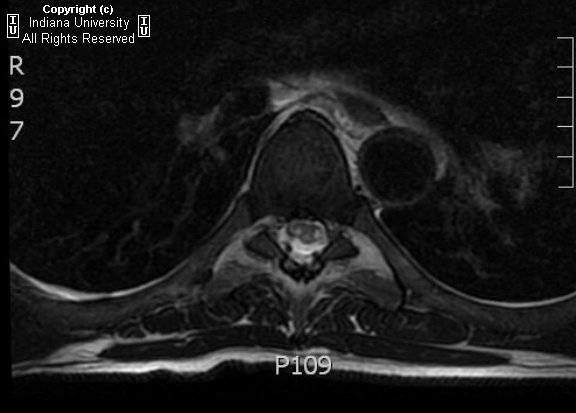
Axial T2 images of cervical cord shows increased T2 signal in both dorsal columns in the form of "inverted rabbit ears". Sagittal T2 images confirm increased T2 signal in the dorsal aspect of the cord corresponding to the location of the dorsal columns. Sagittal T1 with contrast shows no abnormal enhancement of the dorsal columns.

Differential Diagnosis:
- Infectious myelitis such as HIV
- Post infectious myelitis (ADEM)
- Multiple sclerosis
- Copper deficiency

Pathologic correlation: Laboratory testing revealed macrocytic anemia with low serum B12 and normal folate levels. No Intrinsic factor antibodies. Patient clinically improved with subsequent B12 therapy.


Diagnosis: Subacute combined degeneration of the spinal cord from Vitamin B12 deficiency


Discussion

Subacute combined degeneration (SCD) is a reversible cervical myelopathy caused by B12 (cobalamin) deficiency. Findings occur predominantly within the dorsal columns of the lower cervical and upper thoracic spinal cord. The corticospinal and lateral spinothalamic tracts are less commonly involved. B12 deficiency results in macrocytic anemia and neuropsychiatric manifestations including paresthesias, alterations in proprioception, myelopathy, cognitive and behavioral changes.

B12 is a required coenzyme for DNA synthesis and myelination of neurons. Deficiency of the vitamin causes accumulation of methylmalonic acid which is myelin toxic, leading to the neurological manifestations of SCD.

B12 deficiency can be multifactorial although pernicious anemia is the most common etiology. Other causes include malabsorption syndromes, chronic pancreatitis, bacterial over growth, large segment ileal resection, tropical sprue, Dyphillobothrium latum (fish tapeworm) infestation, strict vegetarian diet and rarely from anesthetics.

Nitrous oxide (NO), historically known as "laughing gas" due to the euphoric effects incurred by inhaling the chemical, is found in a popular recreational drug known as "Whippets". NO is also used as an anesthetic agent for surgical procedures. NO has the propensity to inactivate B12 by oxidation precipitating subacute combined degeneration in patients with low or borderline B12 stores.


Imaging

Radiological diagnosis of cervical myelopathy is based on the characteristic symmetrical T2 hyperintensity involving the dorsal columns seen as an " inverted V" or "inverted rabbit ears" on the axial plane. Variable contrast enhancement has been described. Although the findings are typical, SCD is a clinical diagnosis.


lunedì 13 ottobre 2008

Kernicterus


Findings

Increased signal intensity on T1 and FLAIR sequences in the bilateral globi pallidi and hippocampi.

Differential diagnosis:
- Carbon monoxide exposure
- Kernicterus
- Hepatic failure
- Creatine deficiency
- Profound hypoxic encephalopathy


Diagnosis: Kernicterus


Key points

Encephalopathy is due to deposition of toxic unconjugated bilirubin in the basal ganglia, hippocampus, substantia nigra, and brainstem nuclei. It is most often caused by hyperbilirubinemia from erythroblastosis fetalis and most commonly seen in premature infants. It is also associated with early discharge from the hospital. Physiologic and breastfeeding jaundice are benign causes of hyperbilirubinemia.
In the absence of hyperbilirubinemia, factors influencing permeability of the blood-brain barrier (e.g., acidosis, infection) and the amount of unbound (versus albumin-bound) bilirubin may play a role.
Bilirubin-induced neurologic dysfunction (BIND) refers to the clinical signs associated with bilirubin toxicity (i.e., hypotonia followed by hypertonia, opisthotonus or retrocollis, or both).
In the acute phase, neurological findings can include decreased alertness, hypotonia, and poor feeding early on. Later, hypertonia of the extensor muscles is a typical sign. Patients present clinically with retrocollis (backward arching of the neck), opisthotonus (backward arching of the back), or both. Infants who progress to this phase develop long-term neurologic deficits. Prognosis is poor once neurological complications develop. Seizures are not a usual presentation.
Chronic sequelae evolve over the first several years of life. They include extrapyramidal, auditory, and visual abnormalities, and cognitive deficits.
Noncontrast MRI is the most useful imaging modality in the acute and chronic phases. CT is not useful.
MR imaging findings in the acute phase include increased T1 signal intensity in the globus pallidus, hippocampus, substantia nigra, and dentate nucleus. T2 signal may be subtly increased.
MR imaging findings in the chronic phase include increased T2 signal in the posteromedial border of the globus pallidus, hippocampi, and occasionally the dentate nucleus. T1 weighted images are normal.
Preventative treatments include phototherapy. Exchange transfusion is indicated for patients with findings of encephalopathy and serum bilirubin levels >25mg/dL with dehydration.

martedì 29 luglio 2008

T1 hyperintense basal ganglia in a cirrhotic patient


Findings

Axial T1 weighted (SPGR) and sagittal FLAIR sequences demonstrate symmetric, increased signal in the basal ganglia, predominantly the globus pallidi bilaterally, (Figure 1 and Figure 3). However, abnormal increased signal extends from the midbrain (Figure 4), up to the head of the caudate (Figure 2). On T2 weighted images, the basal ganglia are unremarkable (Figure 5).

Differential Diagnosis:
- Deposition of Paramagnetic Substances:
Hemorrhage (methemoglobin)
Manganese (TPN, liver failure)
Copper (Wilson disease)
Melanin
- Calcification (ex-radiation/chemotherapy, hyperparathyroidism, Fahr disease)
- NF1, Halloverden-Spatz syndrome, Fucosidosis
- Japanese encephalitis
- Kernicterus
- Hypoxic-ischemic encephalopathy
- Chorea-Ballism associated with hyperglycemia


Diagnosis: T1 hyperintense basal ganglia in a cirrhotic patient


There are several causes of high T1 signal in the basal ganglia.

Obviously, clinical history or other imaging can be helpful in determining the underlying cause, as in this case. Additionally, the T2 characteristics and pattern of signal abnormality in terms of anatomic location and symmetry may suggest a particular etiology.

Hyperintense T1 signal in the basal ganglia, particularly the globus pallidus, has been observed in patients with chronic liver failure for some time. It has been postulated that paramagnetic substances, especially manganese, escapes hepatic clearance due to dysfunction and/or portosystemic shunting resulting in deposition in the basal ganglia. In a small autopsy series by Maeda et al, 3 patients with cirrhosis and T1 hyperintense basal ganglia all had significantly elevated manganese and copper in the globus pallidus and putamen. 1 patient with cirrhosis and no T1 hyperintense basal ganglia had normal levels of these substances. Individuals receiving TPN have identical findings on MRI, primarily from manganese deposition as well. When manganese is administered parenterally, it escapes the normal regulatory mechanisms, as in cirrhotics. In both patients on parenteral nutrition and those with liver failure, the signal abnormality may regress when TPN is stopped or hepatic function is restored

Characteristic MR findings in the basal ganglia in these patients include symmetric hyperintense signal on T1 weighted images, no signal change on T2 sequences, and no enhancement. CT attenuation in the basal ganglia is normal. The globus pallidus is predominantly involved however abnormal signal may extend from the tegmentum of the midbrain to the white matter. There is a direct relationship between the degree of signal abnormality and amount of deposition in the basal ganglia.